
Note: Odoo 20 is still under development. Roadmap features represent the expected direction of the release and may change before the final version.
If you're currently on Odoo 19 or Odoo 18, this timeline gives you a clear window to evaluate your existing setup and plan for what's ahead, rather than reacting after the fact.
Odoo 20 Accounting: Smarter and More Flexible Financial Management
Accounting received a wide range of improvements in Odoo 20, covering financial reporting, vendor bills, reconciliation, payments, invoice management, and document handling.
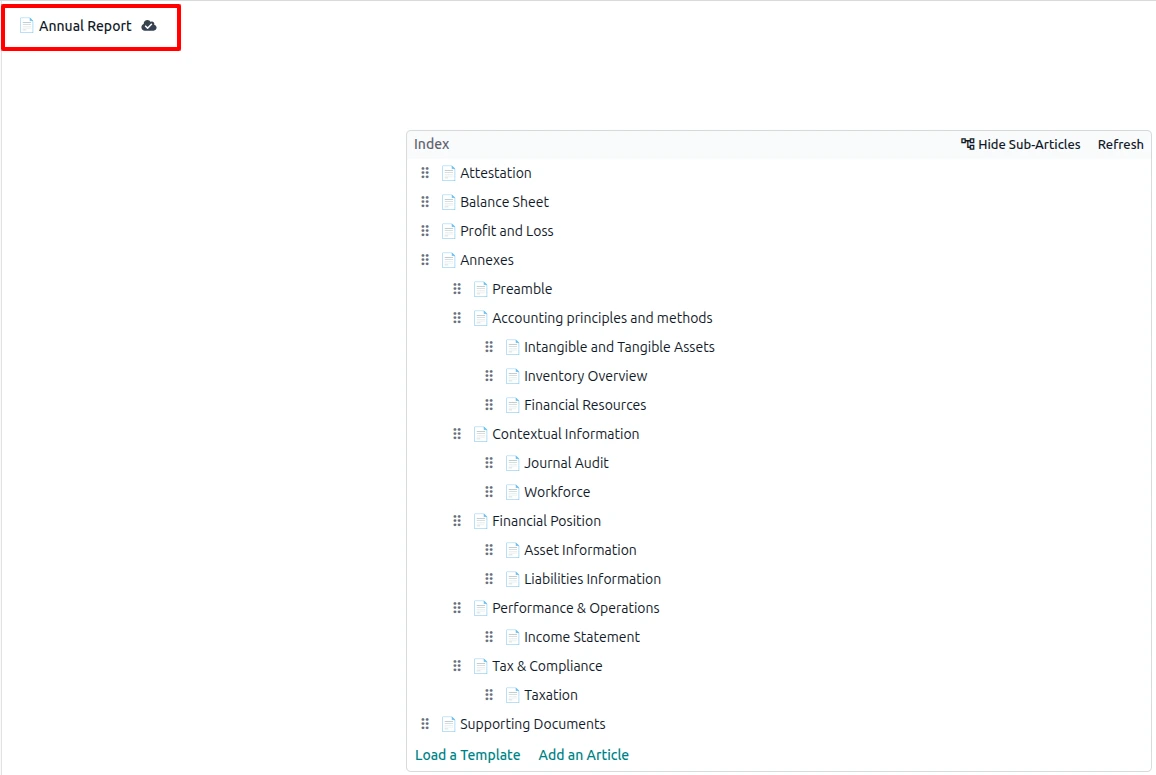
One of the most noticeable reporting improvements is the Annual Report Layout. Annual reports can now use the company's document layout, creating greater consistency between financial reports and other company documents
Another important addition is Bill Line Prediction. When users manually enter or import a vendor bill, Odoo can suggest information for individual bill lines based on historical bills and the line label. This includes the product, account, tax, analytic distribution, and vehicle. Values that have already been manually entered remain preserved.

Invoice management has also become more convenient. Users can select invoices from the list view and download generated attachments together as a ZIP file, including documents such as PDF and XML files.
When sending an invoice by email, documents stored in the Documents application can also be selected and included as invoice email attachments, making supporting documents easier to share with customers.

Odoo 20 also improves duplicate invoice detection. The system can distinguish between invoices that are highly likely to be duplicates and those that are only potential duplicates. Red warnings indicate records that should be corrected, while yellow warnings identify invoices that should be investigated before posting.

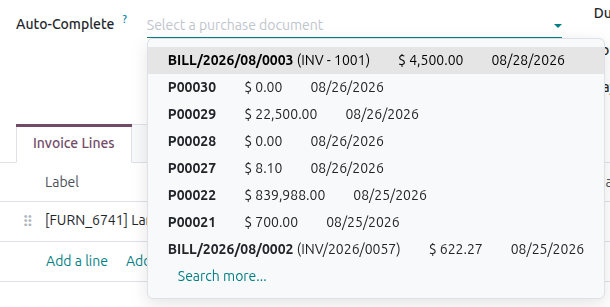
Vendor bill processing receives another improvement through enhanced Purchase Order Matching. Auto-Complete can check existing bill lines before creating new ones, users receive a clearer summary of what has been matched, and Odoo can warn when quantities or prices differ from expectations. Bills and purchase orders can also be unmatched when required.
Bank reconciliation is also easier to control with Run Auto Reconciliation, which allows users to manually retrigger automatic bank reconciliation when necessary.
For invoice accounting, users can open journal items through the invoice smart button and split selected items, providing more flexibility when handling multiple quantities, creating assets, or distributing amounts across different accounts.
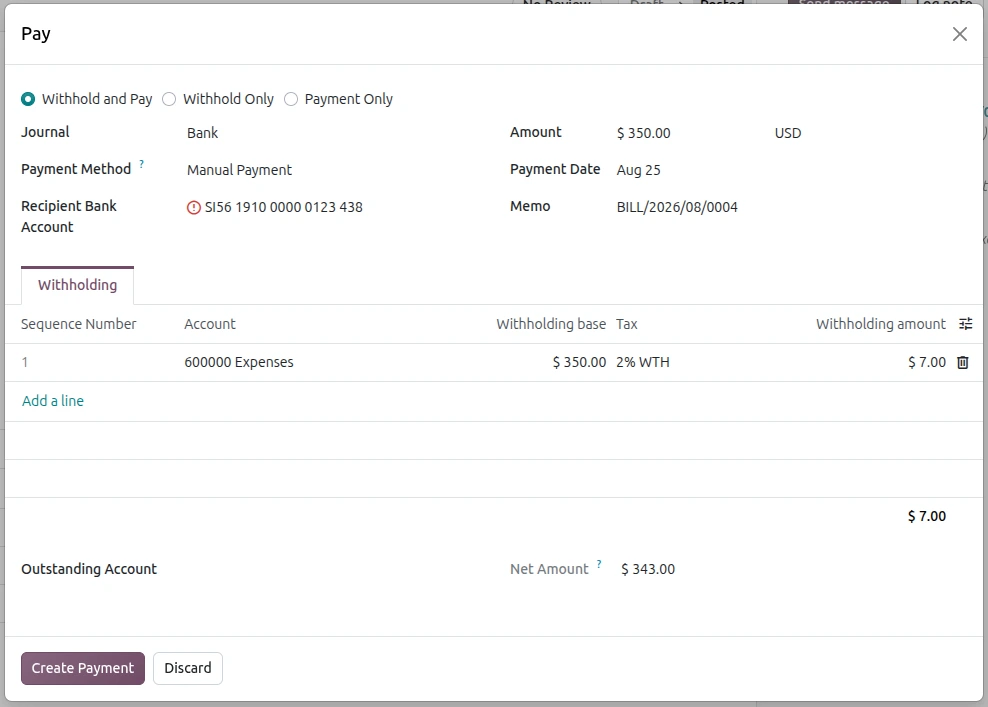
Odoo 20 also improves withholding-tax payments. Bills involving withholding tax can clearly display the Amount Due, Withhold Due, and Net Due, while the payment wizard allows users to choose whether to pay the withholding amount, the payment amount, or the total amount.
Other improvements include moving the PAIN version setting from the journal to the payment-method level and extending the Professional percentage functionality from vendor bills to purchase receipts.
Looking toward Odoo 20 Accounting, the roadmap points toward further improvements such as Pay from Odoo, reconciliation on any account, multiple partner identifiers, and more flexible handling of tax-included and tax-excluded prices.
AI is also expected to play a greater role. The roadmap showcases AI for Accounting for non-CFOs, indicating that Odoo wants to make financial information easier to analyze and understand for users who may not have an accounting background.
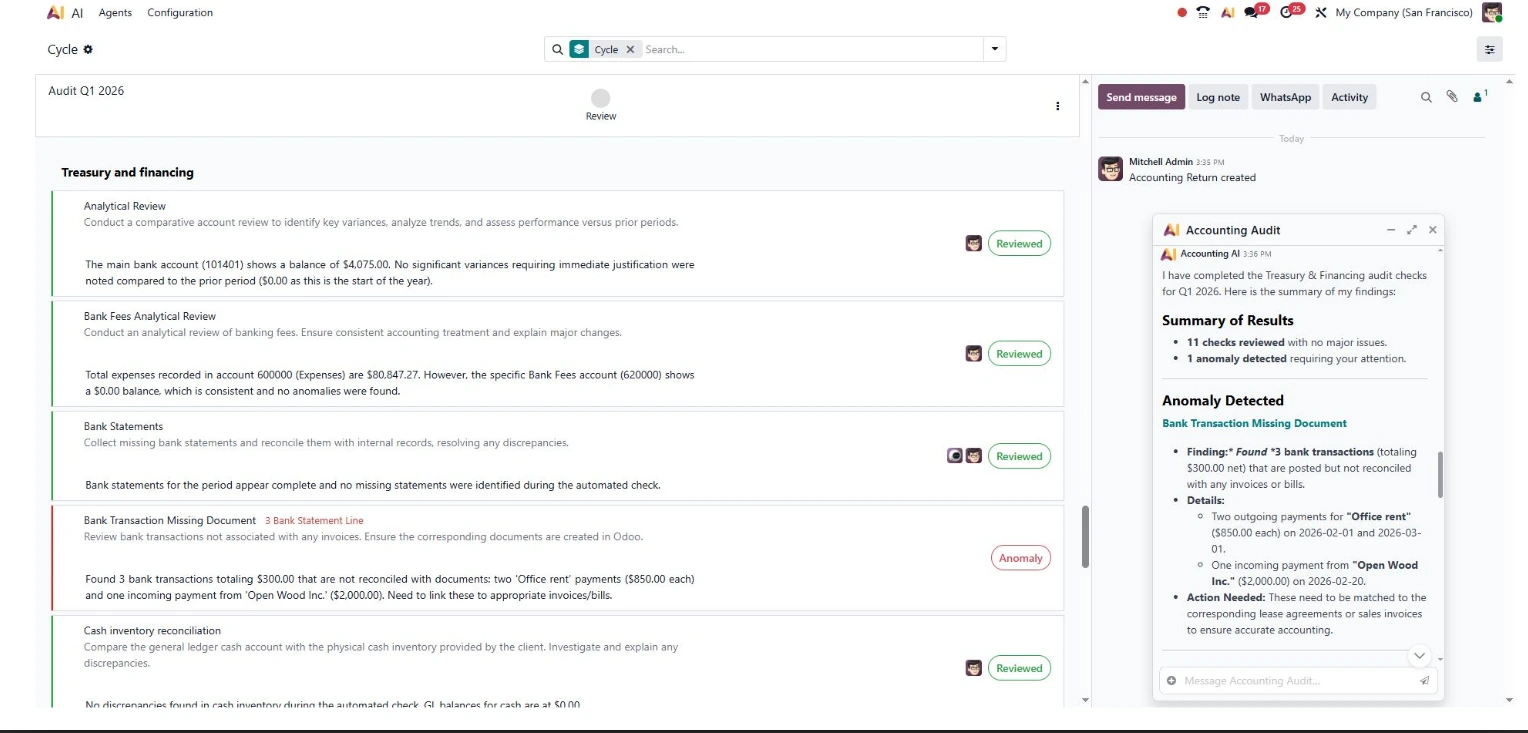
Together, these developments indicate that Odoo 20 Accounting features will continue the shift toward less manual processing, easier financial analysis, and more intelligent assistance.
Odoo 20 CRM: Connecting Opportunities with Customer Growth
CRM receives a focused but useful improvement in Odoo 20 through Upsells from Lead.
Users can access a customer's existing subscriptions directly from a CRM lead or opportunity. From those subscriptions, sales teams can create upsell or renewal quotations that are automatically connected back to the customer's opportunity.

This creates a closer connection between Odoo CRM, Sales, and Subscriptions, allowing salespeople to identify additional revenue opportunities without moving between disconnected customer records.
The Odoo 20 CRM roadmap expands the focus toward multi-pipeline management, new mail plugins, and improved automatic assignment. Combined with Odoo's broader AI capabilities for creating and updating records, CRM is expected to become increasingly automated and connected with the rest of the sales process.
For sales teams, these Odoo 20 CRM features could simplify opportunity management while providing a more complete view of the customer's relationship with the business.
Odoo 20 eCommerce: Improving the Complete Online Customer Journey
Odoo 20 introduces improvements throughout the eCommerce journey, from product discovery and pricing to checkout, delivery, and returns.
The Product Reference Price is now displayed directly on the shop page and other relevant areas by default. This gives customers clearer pricing information while browsing products.
Odoo 20 also introduces two new Ribbon Filters - “On Sale” and “In Stock.” These filters work with automatic ribbon assignment and make it easier for customers to quickly find discounted or currently available products.
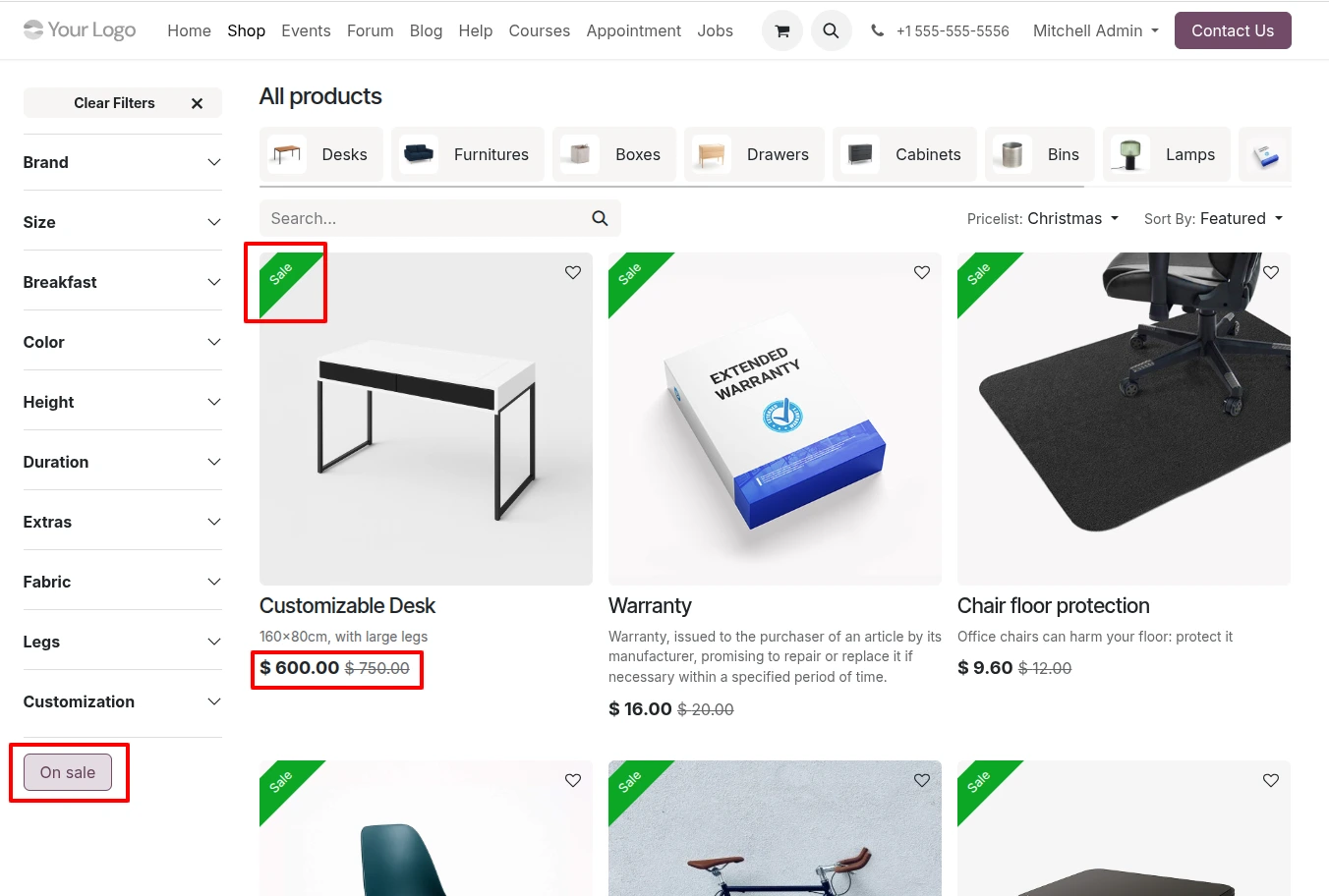
Product searches have also become more precise. When a customer searches using an attribute value, such as “black t-shirt,” opening the result can automatically select the corresponding product attribute value.
External identifiers can also be assigned to attributes, helping businesses meet specific requirements for external product feeds and microdata.
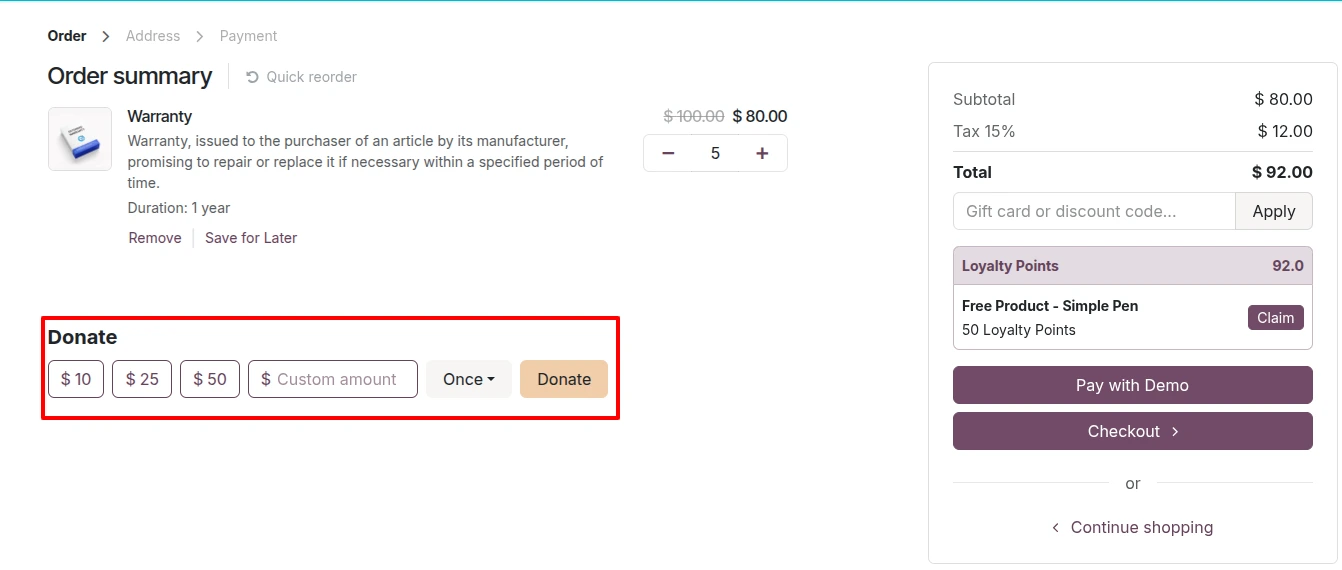
Odoo 20 introduces Donations directly into the eCommerce cart flow as well. Donation snippets can be used during checkout, including support for recurring donations through subscriptions.
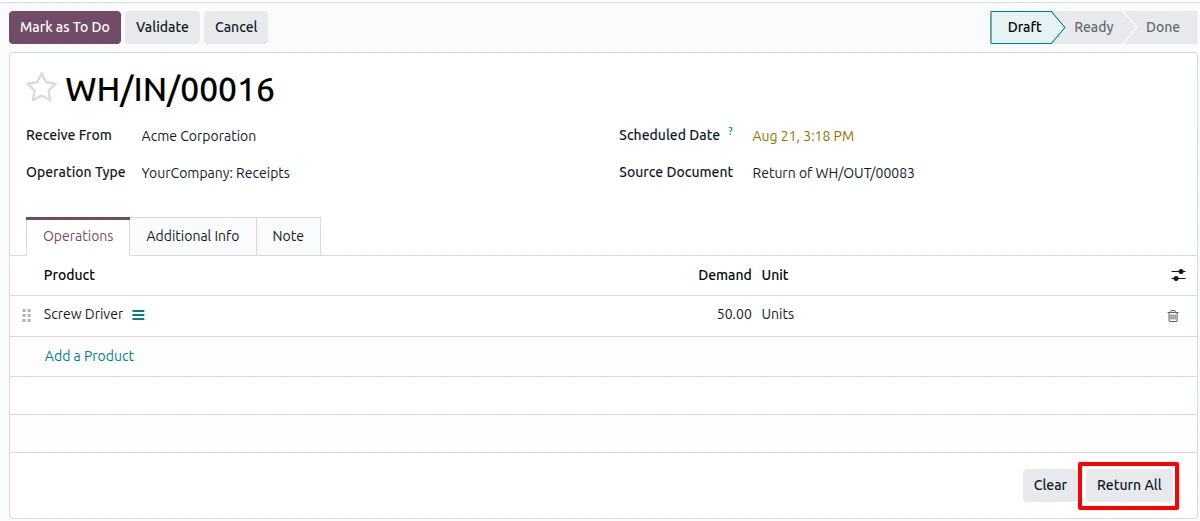
Another important customer-facing improvement is Return Management. Customers can select products they want to return directly through their portal, creating a more convenient post-purchase experience.
For financial integration, businesses can select a default accounting journal for all eCommerce orders, helping standardize the accounting flow behind online transactions.
Mondial Relay pickup points are now handled through Sendcloud rather than a separate Mondial Relay eCommerce module, consolidating pickup-point management with other Sendcloud delivery options.
Looking ahead, the Odoo 20 eCommerce roadmap points toward further improvements including automated cross-selling, standalone catalog pages, return management, dashboards, rating requests, and promotion progress bars.
These Odoo 20 eCommerce features continue Odoo's move toward a more connected shopping experience where product discovery, promotions, transactions, fulfillment, and post-sale interactions can all be managed within the same platform.
Odoo 20 Inventory: Better Stock Visibility and Warehouse Control
Odoo 20 brings several improvements to Odoo Inventory Management, particularly around reporting, traceability, warehouse operations, and Barcode.
The Allocation Report receives a redesigned experience, and stock can now be allocated directly from the Forecast Report. This makes it easier to understand available inventory and decide how stock should be distributed against demand.
[Screenshot needed: Odoo 20 Allocation Report showing stock allocation/forecast information.]
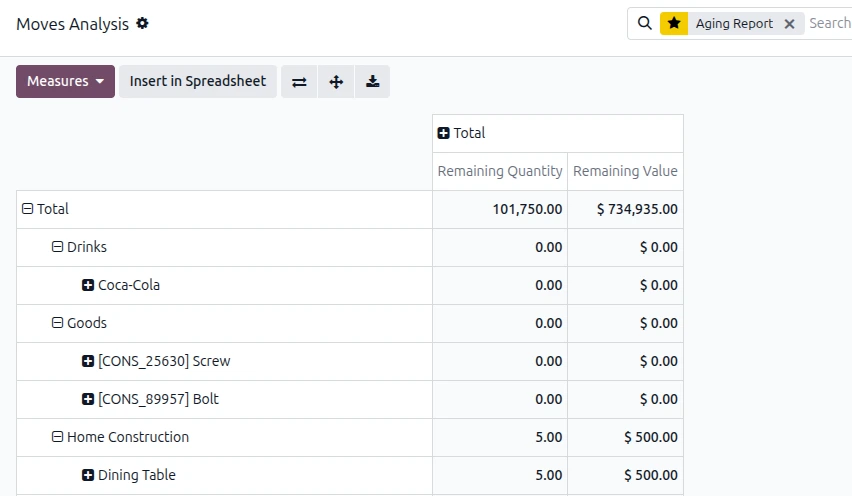
Another useful reporting addition is the Stock Aging Report, available through the Moves Analysis pivot view. It helps businesses analyze how long inventory has remained in stock and identify slow-moving inventory.
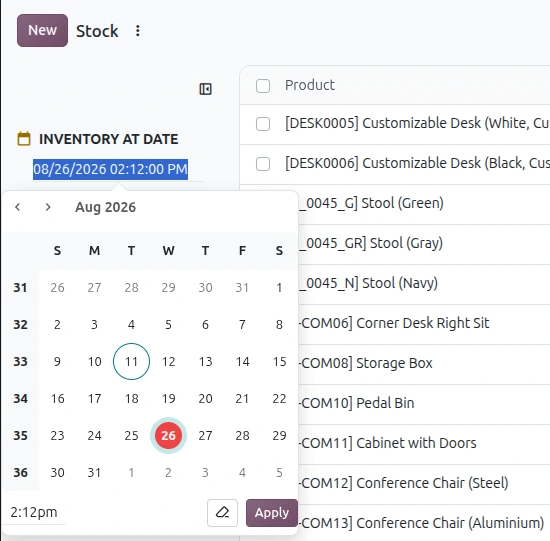
Odoo 20 also improves historical stock analysis through Inventory at a Past Date. A new date picker in the Stock Report allows users to examine inventory at a specific date and precise timestamp while preserving the filters already applied to the report.
Warehouse traceability also improves with the Vendor Purchase Reference appearing directly on receipt transfers. Warehouse operators can identify the relevant vendor reference from an incoming transfer without having to open the related Purchase Order.
Product variants can now carry their own HS (Harmonized System) codes, providing more precise customs and international trade information when different variants require different classifications.
For product packaging, Odoo 20 makes packaging barcodes easier to access and manage directly from the product form.
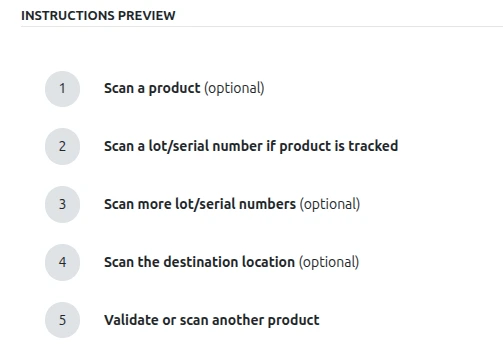
Barcode operations also become easier to configure. Users can preview the Barcode instructions that operators will see directly from the Operation Type configuration.
Users can additionally subscribe to Picking Notifications to receive updates about the status of inventory transfers.
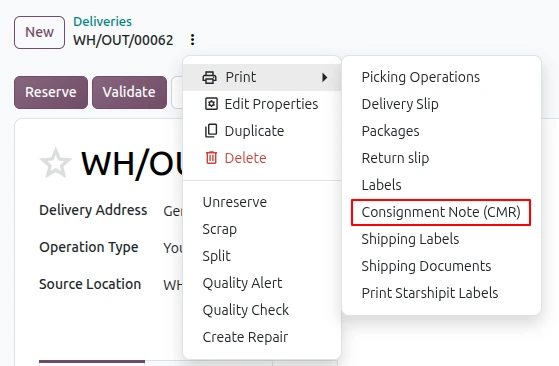
For logistics and transportation, Odoo 20 introduces easier access to CMR documents. A CMR can be downloaded from a delivery with information automatically prefilled from the corresponding transfer.
The Odoo 20 Inventory roadmap continues improving these workflows through better allocation reporting, redesigned product and lot labels, perpetual inventory valuation improvements, inter-company and inter-branch operations, push routes, putaway rules, batches and waves, and pre-encoded packages for Barcode operations.
AI-powered inventory capabilities are also part of Odoo's broader direction, potentially bringing greater intelligence to stock analysis and warehouse operations.
Together, these developments show how Odoo 20 Inventory features are expected to build on the stronger reporting and operational controls introduced in Odoo 20.
Odoo 20 Manufacturing: More Flexible and Visible Production
Odoo 20 introduces several improvements across Manufacturing Orders, Work Orders, Bills of Materials, subcontracting, and traceability.
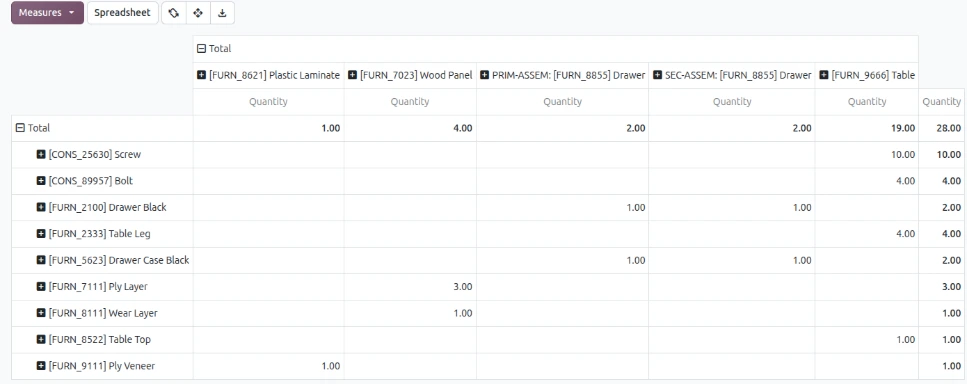
The new Bill of Materials Comparison functionality allows manufacturers to compare BoMs based on the product quantities used, making it easier to understand differences between manufacturing configurations.
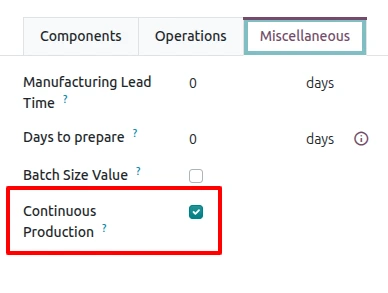
A particularly useful operational improvement is Continuous Production. Produced quantities can now be recorded directly on Work Orders. When Continuous Production is enabled on a Bill of Materials, the next operation can begin as soon as part of the required quantity becomes available rather than waiting for the entire previous operation to finish.
Manufacturers also gain more control over procurement-created Manufacturing Orders. From the Manufacturing Operation Type, businesses can decide whether procurement should create draft or confirmed Manufacturing Orders.
The Manufacturing interface itself has been simplified as well. The separate Produce and Produce All actions have been replaced with a single Produce button across Manufacturing, Shop Floor, and Barcode.
For subcontracted production, the BoM Overview now displays both free-to-use and on-hand quantities across the company's warehouses and the subcontractor's location.

Traceability is also improved with expiration dates appearing directly in the Traceability Report, providing additional information for businesses dealing with lot-controlled or expiry-sensitive products.
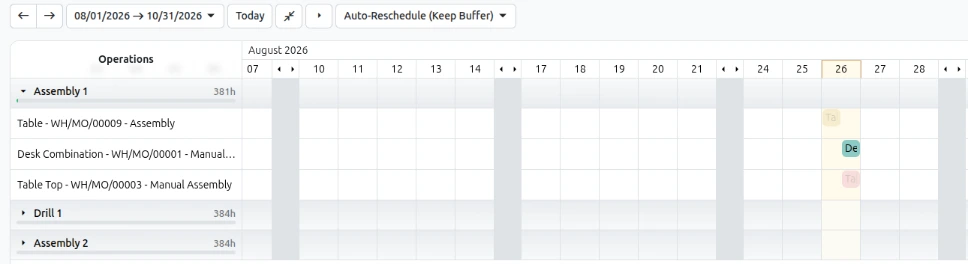
The Work Orders Planning Gantt view now displays completed Work Orders by default, providing a more complete view of production activity.
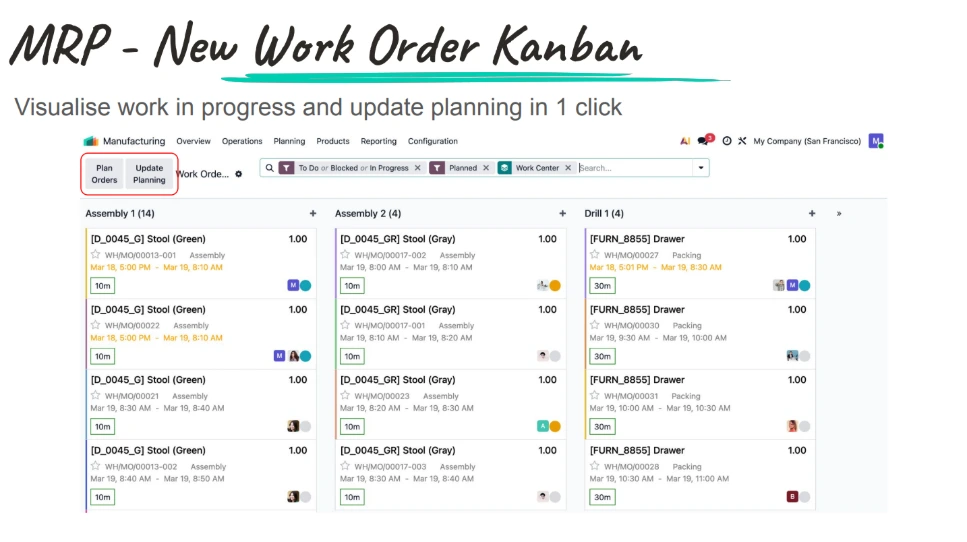
For Odoo 20 Manufacturing, the roadmap points toward a more visual production-management experience with new Manufacturing Order Kanban and Work Order Kanban views. These views are intended to make work in progress, workload, deadlines, and planning easier to understand and manage.
PLM is also expected to gain an ECO Overview Report, bringing engineering changes and their cost impact together in a more consolidated view.
These developments suggest that Odoo 20 Manufacturing features will continue improving production visibility while making planning and day-to-day shop-floor operations easier to manage.
Odoo 20 Sales: More Flexible Quotations, Margins and Commissions

Odoo 20 Website: Better Design, SEO and AI Assistance
Odoo 20 brings improvements across website design, forms, SEO, analytics, mobile responsiveness, themes, and communication.
Website Cards can now trigger animations when visitors hover over them, and an entire card can be made clickable. This gives designers more flexibility when creating interactive landing pages and content sections.

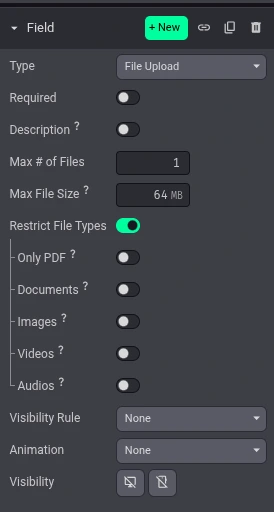
Forms receive several useful enhancements. Businesses can restrict uploaded files to specific file types, apply character limits to text fields, limit email submissions to selected domains, and drag inner-content snippets directly into forms to create sections, add images, titles, and other content.
Odoo 20 also introduces a Font Weight Selector, providing greater control over light, normal, and bold typography.
For responsive website design, users can preview snippets as they will appear on mobile devices, making it easier to identify layout issues before publishing.

Website analytics configuration is simplified as well. Google Analytics or Google Tag Manager can be configured through a single identifier field in Website settings.
SEO receives an important improvement through Structured Data, which is added to webpage HTML by default to help search engines understand page content and support Google Rich Results.
Businesses operating multiple websites can change their default website simply by reordering websites in the configuration, while any webpage can now be designated as the Cookie Policy Page.
The Website Configuration Wizard is particularly relevant to the direction of Odoo 20. In Odoo 20, the wizard already offers AI-powered positioning choices, such as luxury or eco-conscious positioning, based on the type of business. Odoo 20 also introduces new themes, improvements to existing themes, and updated default imagery.
Communication with website visitors also becomes easier through a new WhatsApp Widget snippet, allowing visitors to begin a WhatsApp conversation with the company in a single click.

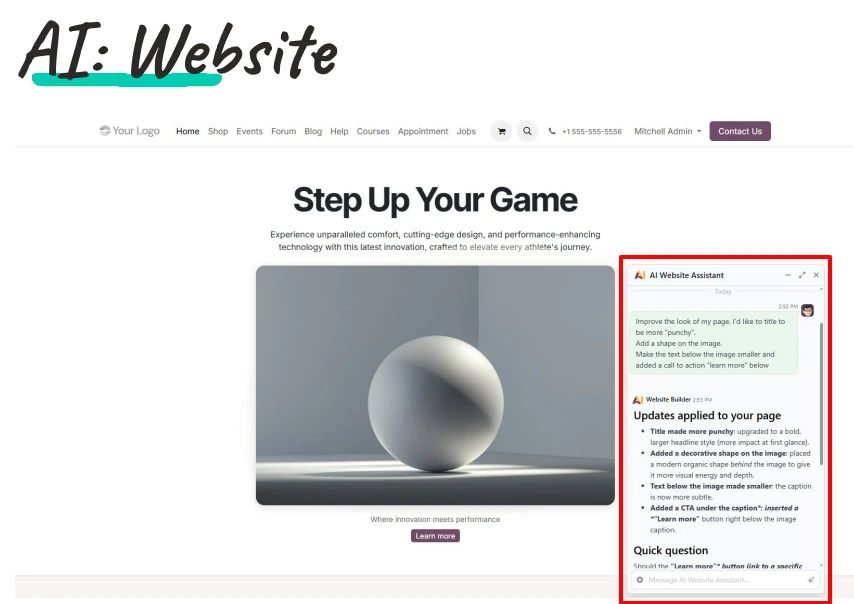
The Odoo 20 Website roadmap goes further with additional AI capabilities, faster loading, improved page hierarchy, JSON-LD microdata, enhanced redirects, sitemap and canonical URL improvements, revamped themes, a redesigned Blog interface, and additional snippet enhancements.
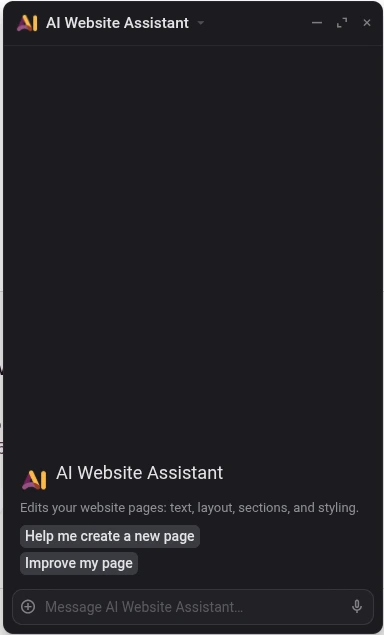
The roadmap's emphasis on AI for Website is particularly significant, indicating that AI assistance is expected to become increasingly integrated into how businesses create and manage websites.
These Odoo 20 Website features can make the Website Builder more useful not only for designing pages but also for managing SEO, content, performance, and digital customer experiences.
AI as a Major Part of Odoo 20
While many Odoo 20 improvements build directly on the functionality introduced in Odoo 20, AI is one of the major themes that separates the upcoming generation of Odoo from previous releases.
The Odoo 20 roadmap demonstrates AI across several business areas rather than positioning it as a standalone tool. AI is shown assisting with Accounting, Website management, record creation, record updates, and other business workflows.
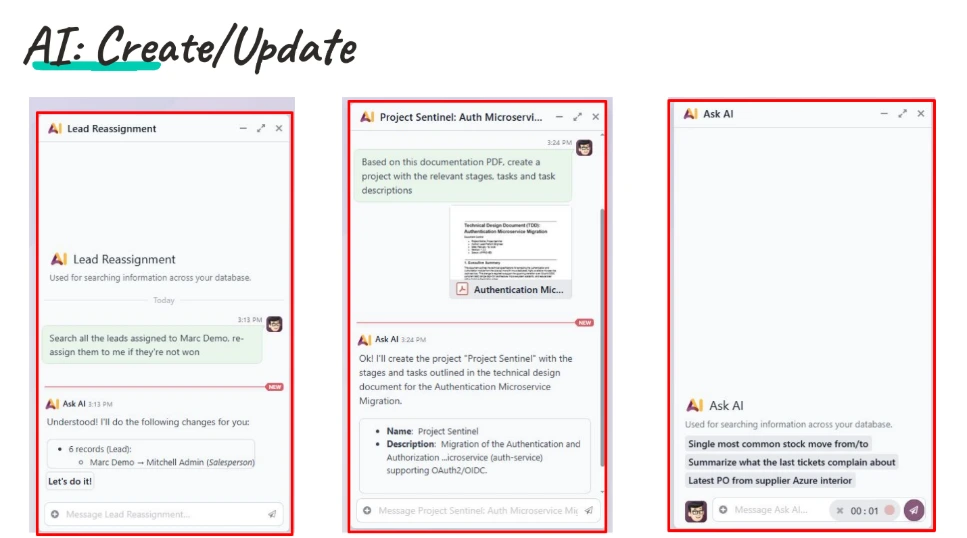
This progression is important because AI inside an ERP can do more than generate text. When connected with Odoo's business data, AI can potentially help users understand information, complete repetitive tasks, interact with records, and make complex ERP functionality easier to use.
Odoo 20 already provides early examples of this direction through capabilities such as Bill Line Prediction and the AI-powered Website Configuration Wizard. Odoo 20 is expected to expand AI further across the platform.
What Does Odoo 20 Mean for Businesses?
Looking at Odoo 20 roadmap it provides a clearer picture of where Odoo is heading. For organizations considering an Odoo 20 upgrade, this provides an opportunity to evaluate existing workflows and determine where new automation, AI capabilities, and usability improvements could create the greatest business value.
At SerpentCS, we help businesses implement, customize, integrate, migrate, and upgrade Odoo according to their operational requirements. As Odoo 20 evolves, our team can help businesses understand the upcoming Odoo 20 features and prepare their Odoo environment to take advantage of the next generation of the platform. Connect with us via contact@serpentcs.com to know more about odoo implementation and migration plans.